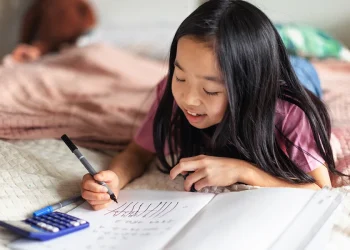



“Ali had 3 times as many stickers as Ben. After Ali gave Ben 12 stickers, they had an equal number. How many stickers did Ali have at first?” A child who can multiply and divide instantly might still stare at that question blankly, not because the arithmetic is hard, but because nothing in it says which operation to use. That’s the specific skill PSLE math is actually testing, and it’s rarely the one raw computation practice builds.
Parents watching this happen often assume it’s a sign their child doesn’t understand math well enough. More often, it’s a sign they understand the numbers just fine and haven’t yet been taught how to read the question in front of them.
Two Different Skills Hiding Under One Subject Name
Computation, working out 3 times 12 correctly, and problem-solving, figuring out that this particular question calls for a model diagram and a bit of ratio reasoning, are genuinely separate skills. A child can be fast and accurate at the first while still being genuinely unsure how to even begin the second. PSLE math leans heavily on the second skill, which is exactly why strong number sense alone doesn’t guarantee a strong PSLE score.
This distinction rarely gets made explicit in casual conversations about a child’s math ability, which is exactly why it’s so easy for a genuine strength in one area to mask a genuine gap in the other.
Why PSLE Math Rewards a Specific Kind of Thinking
Singapore’s primary math curriculum is built around heuristics, model drawing, working backwards, guess-and-check, spotting patterns, deliberately teaching children how to approach an unfamiliar problem rather than just how to calculate once the method is already obvious. PSLE questions are specifically designed to require this kind of interpretation, wrapping a fairly simple calculation inside a scenario the child has to first decode.
Why This Matters Long Before P6
Heuristic thinking isn’t something that develops overnight in the exam year itself; it builds gradually across the primary years through consistent, deliberate practice. Solid primary math tuition in Singapore introduces model drawing and problem-solving strategies well before P6, giving a child years to genuinely internalise the approach rather than cramming it in the final stretch.
Children who only encounter these techniques for the first time in P6 are essentially learning a new skill and revising content at the same time, which is a considerably heavier load than either task alone.
A Couple of Questions Worth Asking Before Choosing a Tutor
Does the tutor focus on heuristics and model drawing, or mainly on drilling more practice sums?
Both matter, but a programme that’s almost entirely computation drills won’t touch the specific gap most PSLE candidates actually struggle with.
Can the tutor explain why a particular method applies to a particular question, not just demonstrate the steps?
A child who only memorises worked examples often struggles the moment a question is phrased even slightly differently from what they’ve seen before.
What Changes Once PSLE Is Actually the Focus
By the exam year, the priority shifts from building the underlying skill set to sharpening it under real exam conditions, timed practice, exposure to a wide range of question types, and targeted work on whichever heuristics a specific child still finds unfamiliar. Focused PSLE math tuition narrows in on exactly this, rather than continuing the broader, slower-paced approach that suited earlier primary years.
The Frustration Parents Often Can’t Quite Explain
It’s a genuinely confusing thing to watch as a parent: a child who seems to understand every concept individually, still losing marks on word problems specifically. The confusion usually isn’t about the child’s intelligence or effort; it’s a mismatch between how the material was practised and how it’s actually being tested, a gap that’s considerably easier to close once it’s correctly identified.
Once a parent sees this distinction clearly, a lot of previously confusing report card comments and test scripts suddenly make considerably more sense.
A child who can compute quickly but can’t decode a word problem isn’t behind on math. They’re behind on a specific, teachable skill that computation drills were never going to build on their own. Naming that gap correctly is usually most of the battle.
The rest, in most cases, comes down to consistent, correctly targeted practice rather than any dramatic overhaul of how a child studies.
Wondering whether the gap is computation or comprehension? Contact Genius Mind Home Tuition and get matched with a tutor who knows the difference.